 语音小管家
语音小管家IEEE 国际声学、语音与信号处理会议(ICASSP)是 IEEE 信号处理学会的旗舰会议,每年汇聚全球信号处理、人工智能、通信、感知与多媒体等领域的顶尖专家学者,围绕相关议题展开交流与讨论,推动信号处理理论、方法及应用的创新发展。第52届 ICASSP 将在加拿大多伦多举办,议程包括国际知名学者的主旨演讲、前沿教程以及前瞻性特别专题。本期整理了 ICASSP 2027 已公布的16场赛事:
大会官网:https://2027.ieeeicassp.org/
01、The First Lunar Pathloss Radio Map Prediction Challenge
赛事官网:lunarradiomapchallenge.github.io/
赛事日程:
- December 16, 2026:Evaluation test data released
- December 20, 2026:Trained models, test code, and radio-map estimates due
赛事简介:Accurate radio-propagation modelling is fundamental to reliable wireless-network design, including emerging extraterrestrial missions. The First Lunar Pathloss Radio Map Prediction Challenge invites participants to develop fast, data-driven alternatives to computationally expensive ray tracing. Using a novel dataset of pathloss radio maps generated through high-fidelity simulations over cratered lunar landscapes, participants will model signal attenuation across complex terrain and multiple frequency bands. The challenge focuses on generalization across reflection, shadowing, and refraction conditions created by continuous elevation changes, supporting future lunar communication and navigation networks as well as rugged terrestrial deployments.
02、CONVERGE Challenge 2027: Multimodal Learning for 6G Wireless Communications
赛事日程:
- September 15, 2026 – Website launch
- October 15, 2026 – Competition launch and data release
- November 30, 2026 – Registration deadline
- December 15, 2026 – Submission deadline
- January 3, 2027 – Results and rankings notification
- January 14, 2027 – Invited 2-page papers due
- January 21, 2027 – Paper acceptance notification
- January 28, 2027 – Camera-ready submission
- May 16-21, 2027 – ICASSP SPGC session and winners announcement, Toronto
赛事简介:Millimeter-wave communication enables high data rates and low latency but is vulnerable to path loss, blockage, and beam misalignment. CONVERGE 2027 invites participants to develop machine-learning solutions that jointly exploit synchronized visual and radio measurements collected in real-world environments. Building on the ICASSP 2026 challenge, the 2027 edition adds a dataset collected at EURECOM in France to the existing INESC TEC/FEUP testbed in Portugal and introduces beam prediction as a new task. Four independent tracks address blockage prediction, user-equipment localization, channel prediction, and beam prediction, promoting collaboration across wireless communications, signal processing, computer vision, and AI.
03、ADD 2026: The Third Audio Deepfake Detection Challenge
赛事日程:
- September 28, 2026 – Registration, training data, and baselines released
- October 15, 2026 – Evaluation datasets released
- November 23, 2026 – Registration deadline
- December 7, 2026 – Submission deadline
- December 21, 2026 – Results and rankings released
- January 7, 2027 – Invited 2-page papers due
- January 21, 2027 – Paper acceptance notification
- January 28, 2027 – Camera-ready papers due
赛事简介:The Third Audio Deepfake Detection Challenge addresses two emerging needs in speech security: detecting live human impersonation and producing transparent explanations for deepfake decisions. Track 1, Audio Impersonation Detection, asks participants to distinguish bona fide speech from recordings produced by professional human imitators. Track 2, Explainable Audio Deepfake Detection, uses genuine and synthetic speech generated by modern text-to-speech and voice-conversion systems and requires both a real/fake prediction and an explicit textual rationale. Researchers in audio forensics, speech processing, machine learning, deepfake detection, and speech-information security are invited to participate in either or both tracks.
04、ICASSP 2027 Audio Editing Challenge
赛事官网:audio-editing-challenge.github.io/
赛事日程:
- September 1, 2026 – Registration opens and guidelines released
- October 1, 2026 – Challenge begins
- November 10, 2026 – Data released and leaderboard opens
- November 25, 2026 – Final submission deadline and leaderboard freeze
- December 7, 2026 – Evaluation and reproducibility checks completed
- December 8, 2026 – Final rankings and invited teams announced
- January 7, 2027 – Invited 2-page papers due
- All deadlines: 11:59 PM U.S. Pacific Time
赛事简介:Recent generative-audio models can follow natural-language instructions to modify speech, music, and environmental sounds, but reliable general-purpose editing remains an open challenge. Participants may enter a Single Model Track, developing a unified end-to-end editor, or an Agent Track, developing an autonomous system that plans, uses open-source models and signal-processing tools, inspects intermediate results, and refines its output. A human-annotated and verified dataset spans speech, music, environmental sound, and mixtures. Rubric-based evaluation measures instruction following, preservation of unrelated content, and exact completion of editing requirements on an unreleased test set.
05、FLAG 2027: Face-voice Association across Languages and Gender
赛事官网:mavceleb.github.io/dataset/competition.html
赛事日程:
- August 24-September 7, 2026 – Registration
- September 1-October 15, 2026 – Progress phase
- October 15-21, 2026 – Evaluation phase
- October 27, 2026 – Results
- October 30, 2026 – System descriptions due
- December 7, 2026 – Challenge paper submission
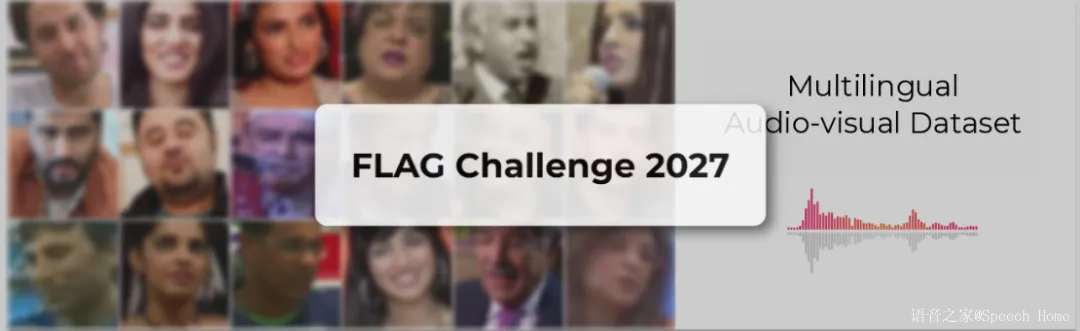
赛事简介:FLAG 2027 evaluates whether face-voice association systems remain reliable across languages and avoid relying on gender as a shortcut for identity. The challenge includes a language-impact evaluation for matching the same speaker across English and Bengali and a gender-controlled evaluation in which negative pairs are selected from speakers in the same annotated gender group. Participants will use the expanded MAV-Celeb benchmark, a pretrained baseline, pre-extracted features, and a CodaBench leaderboard. The challenge aims to advance multilingual, identity-specific cross-modal modelling while encouraging transparent subgroup and uncertainty reporting.
06、RoboHEARD 2027: Robot-centric Embodied Hearing and Dialogue
赛事官网:https://roboheard.github.io/
赛事日程:
- September 15, 2026 – Challenge launch
- October 15, 2026 – Development data and baselines released
- November 15, 2026 – Registration and external-resource declaration deadline
- December 1, 2026 – Test sets and leaderboard released
- December 7, 2026 – Leaderboard freeze
- December 15, 2026 – Technical reports due
- December 22, 2026 – Online-track latency submissions due
- December 30, 2026 – Official rankings released
- January 7, 2027 – Invited 2-page papers due
- January 21, 2027 – Paper acceptance notification
- January 28, 2027 – Camera-ready papers due
赛事简介:RoboHEARD 2027 invites participants to develop multi-speaker, time-stamped audio-visual speech-recognition systems for real mobile robots operating in home-companionship and navigation or shopping-assistance scenarios. Systems must determine who spoke, when they spoke, and what they said using robot-mounted microphone arrays, multi-view cameras, RGB-D cameras, and LiDAR. The challenge offers offline and low-latency online tracks evaluated with time-constrained minimum-permutation character error rate. The completed 80-hour corpus contains separate training, development, and test sets collected with the QUANTA robot, and reproducible baselines and a CodaBench leaderboard will be provided.
07、EAR-1: Embodied Speech Perception under Oracle Navigation in Multi-Party Conversations
赛事官网:earchallenge.github.io/ear1/
赛事日程:
- September 15, 2026 – Challenge launch
- October 15, 2026 – Development data and baselines released
- November 15, 2026 – Registration and external-resource declaration deadline
- December 1, 2026 – Test sets and leaderboard released
- December 7, 2026 – Leaderboard freeze
- December 15, 2026 – Technical reports due
- December 22, 2026 – Online-track latency submissions due
- December 30, 2026 – Official rankings released
- January 7, 2027 – Invited 2-page papers due
- January 21, 2027 – Paper acceptance notification
- January 28, 2027 – Camera-ready papers due
赛事简介:RoboHEARD 2027 invites participants to develop multi-speaker, time-stamped audio-visual speech-recognition systems for real mobile robots operating in home-companionship and navigation or shopping-assistance scenarios. Systems must determine who spoke, when they spoke, and what they said using robot-mounted microphone arrays, multi-view cameras, RGB-D cameras, and LiDAR. The challenge offers offline and low-latency online tracks evaluated with time-constrained minimum-permutation character error rate. The completed 80-hour corpus contains separate training, development, and test sets collected with the QUANTA robot, and reproducible baselines and a CodaBench leaderboard will be provided.
08、XACLE Challenge 2027: X-to-audio Alignment
赛事官网:xacle.org/2027/
赛事日程:
- September 24, 2026 – Dataset and baseline model released
- November 19, 2026 – Evaluation dataset released
- December 3, 2026 – Results and system submission deadline
- December 17, 2026 – Invitations for 2-page papers
- January 7, 2027 – Invited 2-page papers due
- January 21, 2027 – Paper acceptance notification
- January 28, 2027 – Camera-ready papers due
赛事简介:XACLE 2027 focuses on predicting semantic alignment between audio and text for reliable evaluation of x-to-audio generation. Building on XACLE 2026, the new edition shifts from accuracy on seen generation systems to generalization across unseen audio-generation models. Participants will train alignment predictors using audio produced by known models and evaluate them on audio produced by unseen models. The goal is to develop automatic metrics that remain highly correlated with human subjective judgments and continue to work as new text-to-audio and other x-to-audio systems emerge.
09、Agent-Based Fetal Well-being Assessment through Cardiotocography Signals
赛事日程:
- September 30, 2026 – Competition launch and data release
- October 31, 2026 – Registration deadline
- November 15, 2026 – Submission deadline
- December 1, 2026 – Results and rankings notification
- December 7, 2026 – Invited 2-page papers due
- January 11, 2027 – Paper acceptance notification
- January 18, 2027 – Camera-ready submission
赛事简介:Response and revised proposal confirm ethics and release authorization, dataset readiness, label adjudication, missing-data rules, baselines, reproducibility, and secured prize funding. The proposal specifies ten US$1,000 awards (US$10,000 total). Website URL and primary contact email are still needed.
10、Cadenza Challenge 2027: Predicting Lyric Intelligibility (CLIP2)
赛事官网:cadenzachallenge.org
赛事日程:
- 15th June 2026:Challenge launch - rules and documentation.
- 1st July 2026:Release of validation/training dataset.
- 15th July 2026:Release baseline.
- 1st October 2026:Release of evaluation data and opening of the submission window.
- 30th October 2026:Submission deadline. Submission instructions!
- December 2026:Top teams invited to submit 2 page paper for ICASSP
- January 2027:ICASSP camera-ready 2-page papers due.
- 16th-21th May 2027:Session during ICASSP 2027, Toronto, Canada.
赛事简介:The Cadenza Challenge invites participants to predict lyric intelligibility from stereo song excerpts played over loudspeakers by estimating the word-correct rate achieved by human listeners. Standard speech-intelligibility metrics remain unreliable for sung language because singing differs in rhythm and intonation and is embedded in complex musical accompaniment. Building on the ICASSP 2026 CLIP1 challenge, CLIP2 introduces a larger AI-generated music dataset spanning more genres, together with more demanding room acoustics, reverberation, and competing babble noise. The challenge supports improved music accessibility for people with hearing loss, although no prior hearing-loss expertise is required.
11、EEG-sAAD 2027: EEG Selective Auditory Attention Decoding
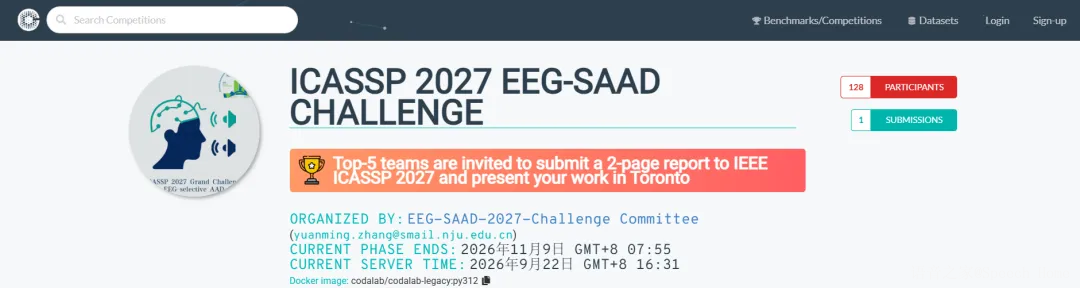
赛事官网:https://www.codabench.org/competitions/17856/
赛事日程:
- September 1, 2026 (23:55 UTC) – Registration, training data, baselines, and development phase open
- November 1, 2026 (23:55 UTC) – Testing phase and blind test data released
- December 1, 2026 (23:55 UTC) – Submission deadline
- December 14, 2026 (23:55 UTC) – Results announced
赛事简介:EEG selective auditory attention decoding aims to identify which speaker a listener attends to in a multi-talker environment, supporting next-generation neuro-steered hearing aids. EEG-sAAD 2027 focuses on cross-dataset generalization: participants train on multiple public datasets from different laboratories and languages, then evaluate on blind test sets with unseen subjects, stimuli, attention switches, and explicit eye-gaze control. Organizers will provide unified-format training data and linear and deep-learning baselines. Rankings combine per-sample decoding accuracy and switch-detection latency through their harmonic mean, and the five highest-ranked teams will be invited to submit two-page ICASSP papers.
12、RTC-SDD 2027: Speech Deepfake Detection in Real-Time Communication
赛事官网:https://www.junxue.tech/rtc-sdd-challenge/
赛事日程:
- September 1, 2026 – Baseline code and progress-stage dataset released
- November 9, 2026 – Final evaluation data released
- November 16, 2026 – Final result submission deadline
- November 23, 2026 – Results and final ranking released
- December 7, 2026 – Invited two-page papers due
- January 11, 2027 – Paper acceptance notification
- January 18, 2027 – Camera-ready papers due
- All deadlines: 11:59 PM U.S. Pacific Time
赛事简介:RTC-SDD 2027 advances robust speech-deepfake detection under realistic real-time communication conditions. Participants determine whether speech received after actual RTC transmission is bona fide or spoofed, despite platform-specific enhancement, codec compression, network transmission, environmental noise, and echo that may distort the artifacts used for detection. Evaluation covers a clean online subset representing standard RTC transmission and a noisy online subset with noise and echo introduced before transmission. The benchmark targets practical generalization across black-box RTC platforms and more reliable protection against impersonation, communication fraud, and misinformation.
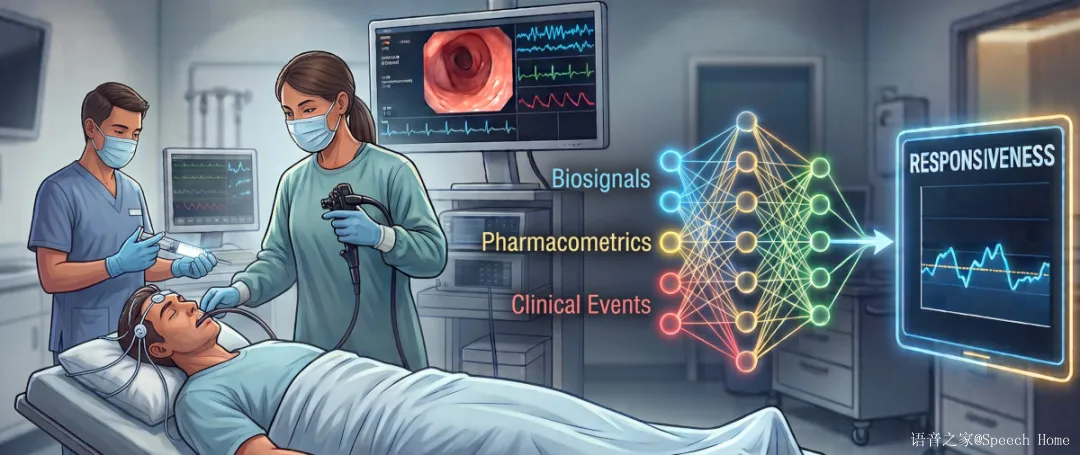
13、DOSE-I Challenge: Forecasting Response to Propofol
赛事官网:https://safe-ai-research.github.io/DOSE-I-Challenge/
赛事日程:
- September 15, 2026 – Website online
- October 1, 2026 – Challenge opens
- December 1, 2026 – Final submission deadline
- December 8, 2026 – Results and invitations
- January 7, 2027 – Invited two-page papers due
赛事简介:DOSE-I asks participants to forecast a clinically observed response to propofol using information available at the time of administration. Teams will predict the future Modified Observer’s Assessment of Alertness/Sedation level approximately 60 seconds after each positive-dose or matched zero-dose episode and, as a secondary task, determine whether responsiveness increased, remained unchanged, or decreased. Public training data will include pre-index EEG, ECG, photoplethysmography, respiration, derived vital and EEG parameters, and propofol history. Final evaluation will use an independent, unreleased clinical cohort, inviting contributions from signal processing, machine learning, clinical monitoring, anesthesia, neuroscience, and consciousness research.
14、Identity-Preserving Video Generation Challenge 2027 (IPVG)
赛事官网:https://hidream-ai.github.io/ipvg-challenge-2027.github.io/
赛事日程:
- August 18, 2026 – Website and call for participation ready
- September 1, 2026 – Training and validation datasets available
- December 9, 2026 – Test sets available for both tracks
- December 16, 2026 – Results submission deadline
- December 17-21, 2026 – Objective evaluation
- December 22, 2026 – Evaluation results announced
- January 7, 2027 – Paper submission deadline
- January 21, 2027 – Paper acceptance notification
- January 28, 2027 – Camera-ready papers due
赛事简介:The Identity-Preserving Video Generation Challenge includes two tracks: Facial Identity-Preserving Video Generation and Sequential Action Identity-Preserving Video Generation. The challenge aims to bring the community together around demanding identity-preserving video datasets and to encourage controllable generative models that bind identity accurately throughout generated video. By testing both facial identity and sequential-action consistency, IPVG seeks to advance more accountable and user-steerable video-synthesis systems.
15、HEARTBEAT Challenge: Human-Centered Embodied Agents
赛事官网:https://heartbeat-challenge.github.io/
赛事日程:
- October 7, 2026 – Registration opens and website goes live
- October 14, 2026 – Data, rules, scoring tools, and baseline systems released
- October 21, 2026 – Development leaderboard opens
- November 20, 2026 – Team membership and resource declarations frozen
- December 4, 2026 – Development leaderboard closes
- December 11, 2026 – Final container submission deadline
- December 18, 2026 – Final rankings and paper invitations announced
- January 7, 2027 – Invited two-page papers due
- January 28, 2027 – Camera-ready two-page papers due
- All deadlines: 23:59 UTC unless otherwise stated
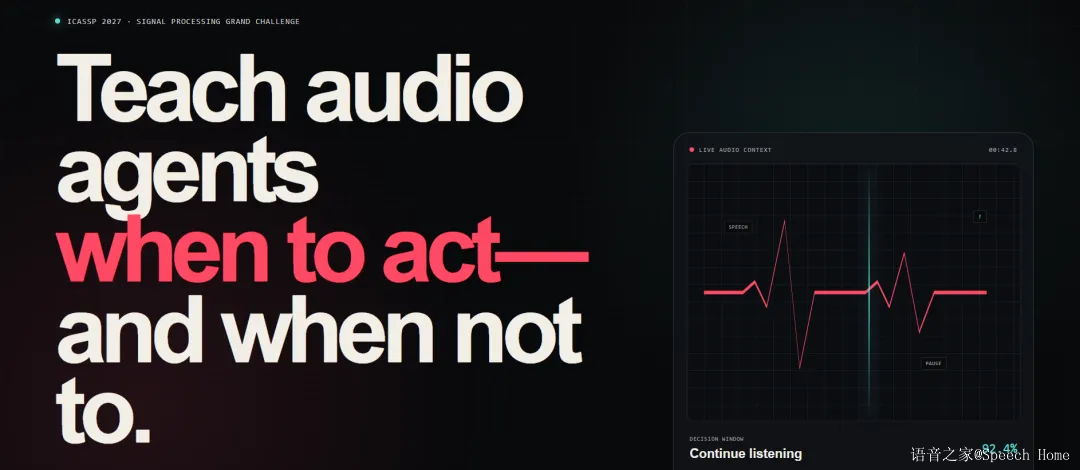
赛事简介:Recent real-time speech, audio-language, and multimodal models enable embodied agents to perceive ongoing interactions and respond with low latency, but existing benchmarks rarely test whether an agent should respond, when engagement is appropriate, or how it should act without unnecessary interruption. HEARTBEAT evaluates timely, context-aware, and human-centered behavior. Participants interpret evolving conversational, environmental, and user-context signals; decide whether to observe or engage; identify an appropriate response time; and select or generate a suitable action. The benchmark includes both response-worthy situations and ambiguous or premature cases where continued listening, monitoring, or abstention is preferable, supporting safer and more natural agents in real-world environments.
16、LRAC 2.0: The Second Low-Resource Audio Codec Challenge
赛事日程:
- August 25, 2026 – Registration opens
- September 1, 2026 – Challenge starts
- November 17, 2026 – Registration closes
- November 30, 2026 – Challenge ends
- December 1, 2026 – Submission deadline
- December 21, 2026 – Notification of results
- January 7, 2027 – Invited two-page papers due
- January 21, 2027 – Paper acceptance notification
- January 28, 2027 – Camera-ready deadline
赛事简介:Traditional speech codecs are lightweight, low-latency, and ubiquitous, but they degrade at low and ultralow bitrates, or do not support them at all. Neural audio codecs (NACs) offer a promising alternative, providing high-quality speech at low and ultralow bitrates, robustness through redundancy coding, and useful representations for downstream tasks. However, deploying these benefits on resource-constrained edge devices remains challenging because state-of-the-art NACs often require substantial computation, memory, and algorithmic latency.
Following the inaugural Low-Resource Audio Codec Challenge (LRAC 1.0, 2025), LRAC 2.0 evaluates neural speech codecs under joint constraints on compute, latency, bitrate, and memory efficiency. The challenge introduces five bitrate caps (1, 6, 12, 24, and 32 kbps) to investigate bitrate scaling toward transparent quality, as well as a dedicated memory-efficiency track with a hard parameter limit and a ranking penalty based on memory bandwidth. The challenge also takes an initial step toward multilingual evaluation: participants train on a fixed, public multilingual dataset, while systems are evaluated in English, Spanish, and Mandarin Chinese using crowdsourced measures of subjective quality and intelligibility.
本次ICASSP2027会议的赛事内容汇总到此结束,后续有更多赛事信息我们会第一时间更新推送,期待大家积极参与、踊跃报名!