
第21届国际语音通讯协会年会INTERSPEECH 2020将于2020年10月25日- 30日全程在线举行。本次大会共邀请到4位重磅嘉宾做大会主题报告(Keynote Talk),涉及的演讲内容包括语言建模、语音听觉感知、口语技术和面向会话应用的底层语音交互技术等四个方面。今天给大家介绍的演讲嘉宾是:IEEE Fellow、ISCA Fellow,国立台湾大学教授Lin-Shan Lee。他将给大家带来题为“Doing Something we Never could with Spoken Language Technologies-from early days to the era of deep learning”的大会报告。
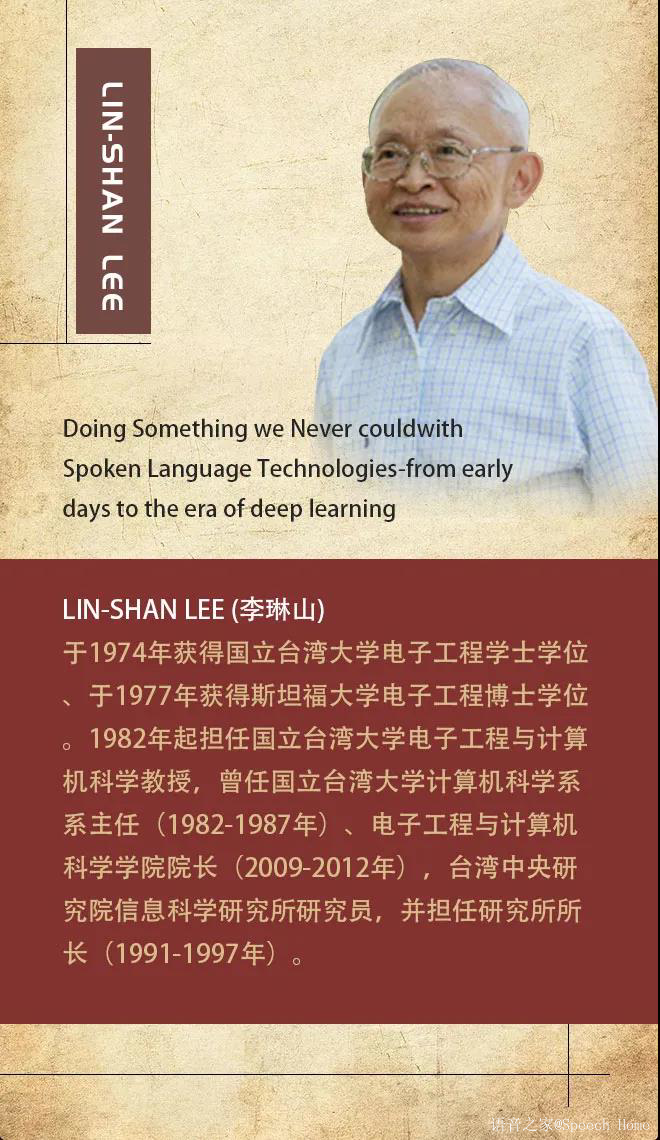
【国立台湾大学教授 · Lin-Shan Lee】
Lin-Shan Lee 教授研究兴趣涵盖通信、语音语言处理和计算机辅助语言学习多个领域,包括数字传输理论、通信信号处理以及语音识别与合成、韵律建模、口语对话、口语内容检索与理解等研究方向。他开发并发布了最早的并且非常完整的汉语口语处理技术,包括语音合成、自然语言句法和语法分析器和大词汇连续语音识别。他还发布了许多世界上最早的汉语口语处理系统,极大地推动了汉语口语处理的发展,包括语音合成系统、自然语言处理分析器,大词汇量语音识别系统、口语内容检索系统和口语对话系统。近年来,他在口语内容检索和浏览方面的主要贡献也得到了全球的广泛认可。
Lin-Shan Lee教授曾在IEEE 通信协会担任多个职务、包括亚太地区主席(1994-1995)、理事会成员(1995-1997)、国际事务副主席(1996-1997)和奖项委员会主席(1998-1999)。他是2002年在台北召开的IEEE Globecom的程序委员会主席、他还曾任ISCA董事会成员(2001-2009),IEEE 信号处理协会的杰出讲师(2007-2008), IEEE Signal Processing Magazine(2003-2006)和IEEE/ACM Trasactions on Audio, Speech and Language Processing (2012-2013)副主编以及ICASSP 2009主席。他在国际顶级会议和期刊上发表了大量的文章,并拥有大量的国内外专利,1992年当选IEEE Fellow,2010年当选ISCA Fellow。
北京时间10月28日18:00到19:00,Lin-Shan Lee教授将发表题为“Doing Something we Never could with Spoken Language Technologies-from early days to the era of deep learning”的主题演讲,欢迎大家在线观看。
Keynotes:
Title: Doing Something we Never could with Spoken Language Technologies - from early days to the era of deep learning
Time: Wednesday, 28 October, 18:00-19:00 (GMT+8)
Speaker: Lin-shan Lee, National Taiwan University
Abstract:
Some research effort tries to do something better, while some tries to do something we never could. Good examples for the former include having aircrafts fly faster, and having images look more beautiful; while good examples for the latter include developing the Internet to connect everyone over the world, and selecting information out of everything over the Internet with Google to name a few. The former is always very good, while the latter is usually challenging. This talk is about the latter.
A major problem for the latter is those we could never do before was very often very far from realization. This is actually normal for most research work, which could be enjoyed by users only after being realized by industry when the correct time arrived. The only difference is here we may need to wait for longer until the right time comes and the right industry appears. Also, the right industry eventually appeared at the right time may use new generations of technologies very different from the earlier solutions found in research.
In this talk I'll present my personal experiences of doing something we never could with spoken language technologies, from early days to the era of deep learning, including how I considered, what I did and found, and what lessons we can learn today, ranging over various areas of spoken language technologies.