SpandLDeteriorate 研讨会将于北京时间2024年12月3日(周二)8:45-11:45在新西兰奥克兰举行。研讨会将以线上和线下两种方式同时进行,欢迎大家参加!
本次研讨会主要针对计算机视觉、NLP、音频分析和生物信息等在数字健康领域的应用。会议邀请到了中国科学技术大学袁家宏教授与澳洲墨尔本大学Mike Conway 高级讲师为我们做keynote报告。并有三篇论文受邀进行oral presentation。
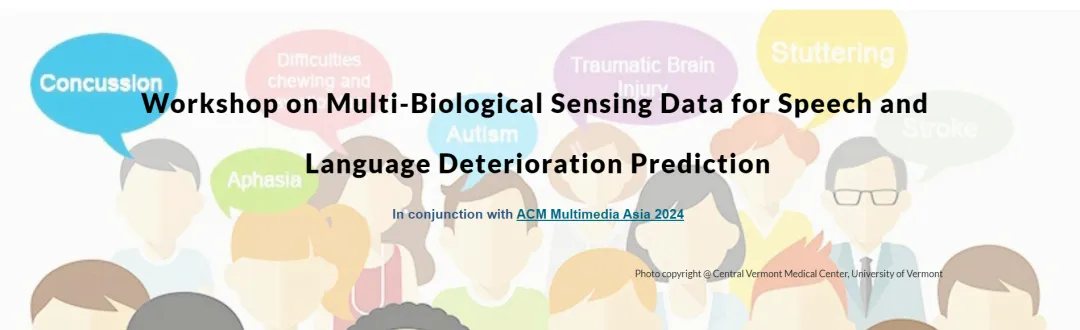
研讨会网站:https://sites.google.com/view/spandldeteriorate
线上参会
会议链接:https://massey.zoom.us/j/81299815991?pwd=MkjzP3cctP7JOXP90E7Vu5dS9P5HyU.1
Meeting ID: 812 9981 5991
Password: 184575
议 程
| 13:45-14:00 | Opening |
| 14:00-14:45 | Keynote 1: Challenges in Clinical Natural Language Processing (Dr. Mike Conway) |
| 14:45-15:00 | Paper Presentation: Reference-free automatic speech severity evaluation using acoustic unit language modelling (Bence M Halpern) |
| 15:00-15:15 | Paper Presentation: Free-FreeSLT: A Gloss-Free, Parameter-Free model for Sign Language Translation (Weirong Sun) |
| 15:15-15:30 | Break and Afternoon Tea |
| 15:30-16:15 | Keynote 2: Research on Automatic Detection of Alzheimer's from Speech: Progress and Reflections (Dr. Jiahong Yuan) |
| 16:15-16:30 | Paper Presentation: Swin-BERT: A Feature Fusion System designed for Speech-based Alzheimer's Dementia Detection (Yilin Pan) |
| 16:30-16:45 | Close |
报告嘉宾

袁家宏
中国科学技术大学
主题:Research on Automatic Detection of Alzheimer's from Speech: Progress and Reflections
摘要:Language impairments in Alzheimer's Disease (AD) manifest across various levels of linguistic structure. Leveraging the Transformer model and the pretraining-finetuning approach, machine learning can effectively capture and utilize these features for automatic AD recognition.
Our research demonstrates that incoporating pause encoding in word transcription, combied with pre-trained language models that integrate pause information, significantly enhances the accuracy of automatic AD recognition. This talk presents thse findings and explores the potential of contextual pauses as a biomarker for AD. Additionally, it will discuss the challenges and strategies involved in constructing speech datasets for AD detection.

Mike Conway
澳洲墨尔本大学
主题:Challenges in Clinical Natural Language Processing
摘要:Abstract: The application of Natural Language Processing (NLP) methods to real-world clinical text data derived from Electronic Health Records has the potential to improve quality of patient care, enhance the efficiency of healthcare systems, and support clinical and public health research. However, working with clinical text is challenging.
In this talk I will attempt to do four things. First, I will describe the broad terrain of clinical NLP, including applications in clinical decision support and epidemiology research. Second, I will outline some of the distinctive challenges involved in developing clinical NLP algorithms. Third, I will describe current methods and resources used in clinical NLP applications. Finally, I will present the argument that -- at least as things stand in late 2024 -- Large Language Models are often not well suited for some clinical NLP tasks.
组织者